

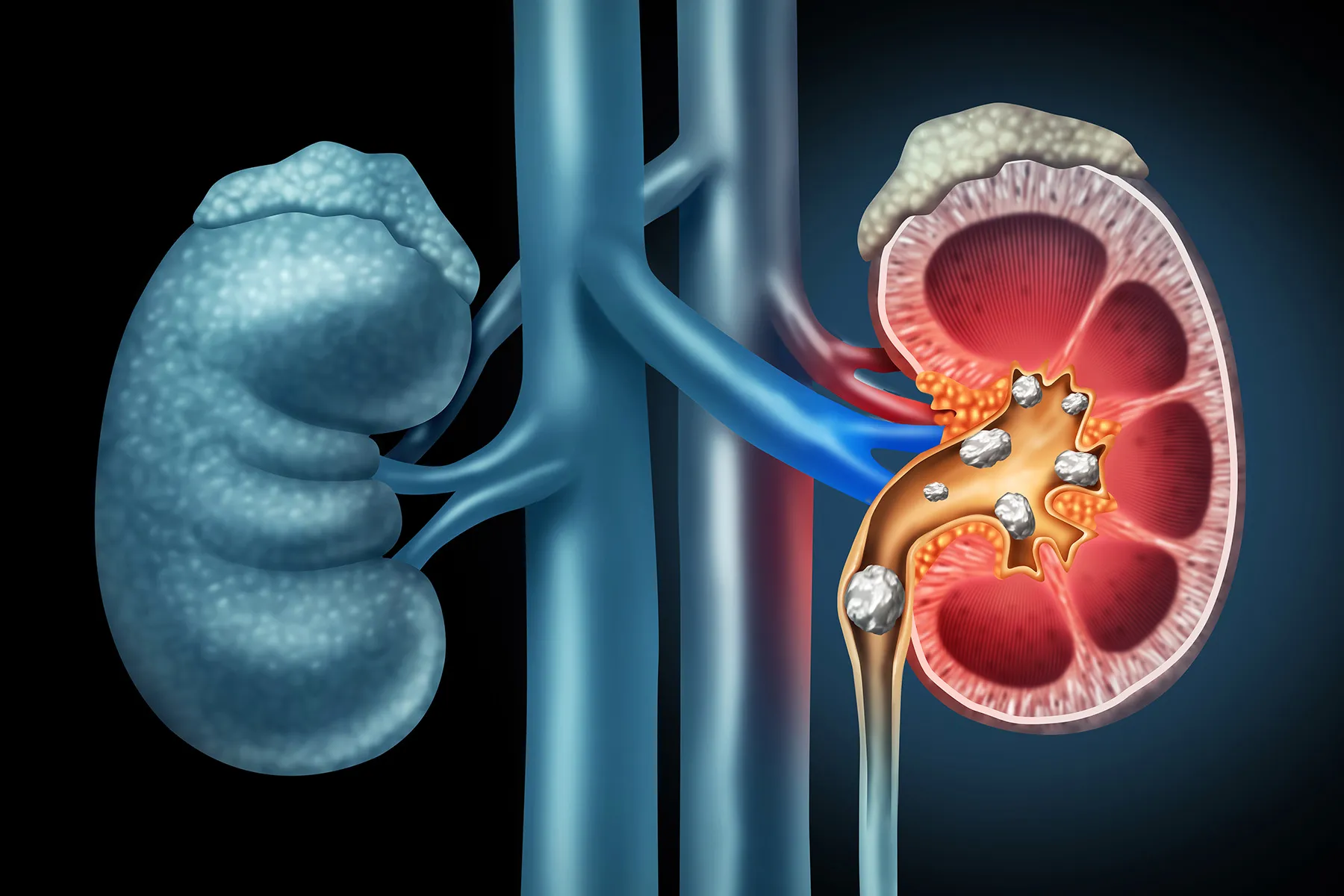
Kidney stones affect roughly one in ten Americans at some point in their lives, and recurrence rates are high enough that a first stone is often not a last one. Most people who have had one describe the pain as among the worst they have experienced, which makes the topic feel urgent even when the stone has already passed. Understanding what kidney stones actually are, what determines whether one will pass on its own or require intervention, and what the evidence says about prevention is where every patient should start. At Lazare Urology in Brooklyn, kidney stone evaluation and treatment is a core part of the practice, and the questions patients come in with are almost always the same practical ones this piece is designed to answer.
What Kidney Stones Are and How They Form
Kidney stones are hard deposits of minerals and salts that crystallize inside the kidneys when urine becomes supersaturated with substances that would otherwise stay dissolved. The most common type, accounting for roughly 80 percent of all stones, is calcium oxalate. Calcium phosphate stones are the next most frequent. Uric acid stones make up about 10 percent of cases and are more common in men with gout, obesity, or type 2 diabetes. Struvite stones, which form in association with chronic urinary tract infections caused by specific bacteria, and cystine stones, which result from a rare genetic disorder, are less common but worth knowing about because their treatment and prevention differ from the calcium-based varieties.
The reason urine becomes supersaturated enough to form crystals is usually a combination of dehydration, diet, and individual metabolic factors. Some people absorb oxalate from food more readily than others. Some have hypercalciuria, meaning their kidneys excrete unusually high amounts of calcium into the urine. Some produce low levels of citrate, a natural inhibitor of crystal formation. Stone formers often have more than one of these tendencies operating simultaneously, which is why prevention is not a one-size approach and why a metabolic workup after a first stone is genuinely useful.
Will the Stone Pass on Its Own? The Size and Location Question
Whether a kidney stone will pass without intervention depends primarily on its size and where it is sitting in the urinary tract at the time of diagnosis. These two factors are the starting point for every conversation about management.
Stones smaller than 4 millimeters pass spontaneously in roughly 80 percent of cases. Stones between 4 and 6 millimeters pass about 60 percent of the time. Once a stone exceeds 6 millimeters, the passage rate drops to around 20 percent, and stones larger than 10 millimeters almost never pass without intervention. These are population-level probabilities, not individual guarantees, but they give a realistic framework for deciding how long to wait before pursuing treatment.
Location matters alongside size. A stone in the lower ureter, the section closest to the bladder, is in the best position to pass. Stones stuck higher in the ureter or still sitting in the kidney are less likely to move quickly. A stone lodged at the ureteropelvic junction, where the ureter meets the kidney, can obstruct urine flow from the kidney entirely, which is a situation that requires more urgent attention than a stone casually working its way toward the bladder.
Alpha-blocker medications, typically tamsulosin, are sometimes prescribed during watchful waiting to relax the ureteral muscle and facilitate passage. The evidence for their efficacy is stronger for larger stones in the distal ureter than for smaller ones, and their benefit is modest but real for patients who are appropriate candidates.
When Watchful Waiting Is No Longer the Right Call
There are circumstances in which waiting for a stone to pass on its own is not appropriate regardless of size. Any of the following warrant urgent urological evaluation:
• Fever accompanying flank pain, which suggests a concurrent kidney infection behind the obstruction and is a potential surgical emergency
• A solitary kidney, where obstruction cannot be tolerated as long as it might be with two functioning kidneys
• Uncontrolled pain despite appropriate analgesics, indicating the stone is causing more distress than conservative management can address
• Complete obstruction of urine flow, confirmed on imaging, that risks lasting kidney damage if not relieved
• A stone that has not moved or passed after four to six weeks of conservative management
Ureteroscopy: What the Procedure Actually Involves
Ureteroscopy is the most common procedural treatment for kidney stones that require intervention. A thin, flexible or semi-rigid scope is passed through the urethra and bladder and up into the ureter or kidney to reach the stone directly. A laser, typically holmium laser lithotripsy, is used to break the stone into small fragments that can either pass on their own or be removed with a small basket instrument. The procedure is performed under general anesthesia and takes between 30 and 90 minutes depending on the stone’s size and location.
Most patients go home the same day. A ureteral stent, a thin plastic tube that keeps the ureter open while swelling resolves, is often placed at the end of the procedure and removed in the office one to two weeks later. The stent causes noticeable urinary urgency, frequency, and sometimes mild discomfort during its time in place, which is normal and resolves after removal.
Shock wave lithotripsy, or ESWL, is an alternative for certain stones that uses external sound waves to break up the stone without a scope. It works best for smaller stones in the kidney or upper ureter and cannot be used effectively for very hard stones like calcium oxalate monohydrate or cystine. Ureteroscopy has largely replaced ESWL as the preferred approach in many practices because it offers higher stone-free rates and more precise fragmentation.
Evidence-Based Prevention: What Actually Reduces Recurrence
The single most impactful thing a stone former can do is drink more water. The target is producing at least 2.5 liters of urine per day, which requires drinking enough fluid to get there accounting for losses through sweat, respiration, and other routes. In practical terms, for most people in a temperate climate doing moderate activity, this means roughly 2.5 to 3 liters of fluid intake per day. Urine should be pale yellow. Dark yellow urine is a reliable indicator that concentration is high enough to favor crystal formation.
Dietary sodium is a less intuitive but clinically significant factor. High sodium intake increases urinary calcium excretion, which raises the concentration of calcium in the urine and increases the risk of calcium stone formation. Reducing sodium to less than 2,300 milligrams per day is a meaningful preventive measure, particularly for patients with documented hypercalciuria.
The long-held advice to restrict calcium intake for calcium stone formers is outdated and counterproductive. Dietary calcium binds oxalate in the gut before it can be absorbed and excreted in the urine. Restricting calcium paradoxically increases urinary oxalate and raises stone risk. The recommendation now is to maintain normal dietary calcium intake, roughly 1,000 to 1,200 milligrams per day from food sources, while moderating calcium supplement use.
High dietary oxalate does contribute to risk for calcium oxalate stone formers, and sources like spinach, almonds, chocolate, and certain teas are worth moderating rather than eliminating entirely. Animal protein drives uric acid production and reduces urinary citrate, both of which favor stone formation. Increasing dietary citrate through lemon juice or potassium citrate supplementation is a targeted approach for patients with low urine citrate levels.
The 24-Hour Urine Test: Why It Changes Prevention Entirely
A 24-hour urine collection, analyzed for calcium, oxalate, uric acid, citrate, sodium, and total volume, tells a urologist exactly which risk factors are operating in a specific patient. Without it, prevention advice is generic. With it, recommendations become targeted: a patient with high urine oxalate gets different guidance than one with high calcium and normal oxalate, even though both form calcium oxalate stones. After a second stone or a particularly large first stone, this test is one of the most useful tools available.
Getting Evaluated and Treated at Lazare Urology in Brooklyn
A kidney stone evaluation at Lazare Urology involves imaging to locate and size the stone, an assessment of kidney function and drainage, and a discussion of whether watchful waiting or procedural intervention is appropriate given the specific situation. For patients who have had multiple stones, a metabolic evaluation including 24-hour urine testing is available to identify the underlying drivers and build a prevention plan around them.
Ureteroscopy with laser lithotripsy is performed by Dr. Jon Lazare for patients who require intervention, in a setting designed for efficient, personalized care rather than the impersonal environment of a hospital urology department.
If you are currently passing a stone, have recently passed one, or have been told you have a stone on imaging and are not sure what to do next, contact Lazare Urology today. Getting the right information early makes every subsequent decision easier, whether that means waiting, treating, or building a plan to prevent the next one.
